
Yes! Generally speaking, most of us want to be consuming a high fiber diet. I was recently interviewed by the San Francisco Chronicle on the topic of fiber, so thought I would share and also expand on the topic. For the SF Chronicle interview, click here.
Did you know that, in America, 90% of women and 97% of men don't eat enough fiber in their diets? A low fiber intake doesn't just affect digestion--it deprives your gut microbiome of the nutrients it needs to stay balanced and thriving, impacting both your gut health and your overall well-being. Why do so many fall short on fiber? An excessive consumption of ultra-processed foods and an inadequate intake of fiber-rich vegetables, fruits, and plant foods. In the U.S, ~70% of calories consumed consist of ultra-processed foods.
Adding more fiber to your diet is a simple, effective step toward improved gut health and well-being. Here's why:
Balances the microbiome
Fiber nourishes beneficial bacteria, supporting the balance that's essential for gut health
Aids digestion
Helps keep things moving smoothly and supports regularity by adding bulk and absorbing water
Boosts energy
Assists in optimizing metabolism for consistent energy all day long
Per the American Diabetes Association, it’s recommended that women have 25 grams of fiber per day and men consume 38 grams of fiber per day. You know I set high standards, so I would say that 30-45 gm fiber daily is optimal. Not only are so few Americans reaching their fiber goal, most are falling 50% short of their goal. Yikes! Continuing low levels of fiber intake is likely to soon be considered a public health concern. Eating plenty of food higher in fiber can lead to improvements in your gut health and so many other benefits as well.
How do you reach 30 gm fiber daily?
Eat 3 cups or more of vegetables daily
Eat ½ cup fruit twice daily
Include 2 tbsp ‘fiber booster’ daily – sacha inchi seeds, ground flax seed, chia seeds, &/or basil seeds
There are essentially two types of fiber:
Soluble fiber: This type of fiber helps slow digestion and the rate at which carbohydrates and other nutrients are absorbed in your body. Soluble fiber can help control your blood sugar by preventing rapid rises or spikes. Additionally, soluble fiber provides form to your stool, so can be useful for diarrhea. You can get soluble fiber from foods like oats, beans, peas, fruits, nuts, and vegetables.
Insoluble fiber: The insoluble form of fiber helps move things through your body and provides “bulk,” which helps to prevent constipation and keep you regular. You can get insoluble fiber from foods like fruits, vegetables, nuts, seeds, and whole grains.
BOTH forms of fiber make you feel full, which can prevent you from overeating!
Any time one increases dietary fiber, I recommend doing so slowly to help your body adjust. When fiber-rich foods are added quickly and suddenly to the diet, you may experience a temporary period of abdominal bloating and discomfort. To avoid digestive distress, aim for increasing fiber roughly 5 grams each week. I also recommend increasing your intake of water to help prevent constipation.
The best way to check your fiber intake is by reading the nutrition facts label on your food, or by familiarizing yourself with the fiber contained in your fave fruits and vegetables. Fiber is listed under the “carbohydrates” section on packaged food labels. In general, look for foods with more than 3 grams of fiber per serving. I also suggest the 10:1 rule. For every 10 grams of carbohydrates listed on a label, be sure that there is at least one, preferably more, grams of dietary fiber.
Need some fiber-full suggestions?
Here are some of my favorite ways to incorporate more fiber into your diet:
1. Include vegetables with every meal or nearly every meal you eat
Add leftover dinner veggies to your eggs
Include leafy greens or riced cauliflower in your smoothies
Add extra frozen veggies to soups
2. Choose fruits as snacks, salads, and desserts
½ cup of sliced avocados = 4.5 grams of fiber
1 medium pear = 6 grams of fiber
1 medium apple (with skin) = 4 grams of fiber
½ cup of raspberries = 4 grams of fiber
3. Add healthier choices to your snack arsenal
Raw, cut-up vegetables like red and yellow peppers, broccoli florets, carrots, and cauliflower
A mere 2 tablespoons of sacha inchi seeds provides 5 grams of fiber
A ¼ cup of pistachios provides 3 grams of fiber
3 cups of air-popped popcorn have 3.5 grams of fiber
4. Opt for winter squash and/or look for “whole”-grain items that are minimally processed
For example: Sweet potatoes, delicata squash, butternut squash, quinoa, oats, brown rice
5. Add some beans or lentils
To your soups, salads, and side dishes. Or, serve them as the main dish! Adding ½ cup of dried split peas to soup provides a whopping 25 grams of fiber.
6. Include resistant starches in your diet
Certain foods contain starches that are resistant to digestion. These "resistant starches" go on to be fermented in your large intestine. These fibers serve as a fuel source for our gut-microbiome’s bacteria. The bacteria are then able to produce protective short-chain fatty acids, including butyrate. Research has shown eating resistant starches can have benefits to blood-sugar responses and insulin sensitivity as well. Examples of resistant starches include green bananas, plantains, and cooked and cooled starches such as sweet potatoes, rice or potatoes.
3-Ingredient Everything English Muffin 🌟
I found this recipe on Instagram and had to try it – a gluten-free, grain-free, ‘bread’ type of recipe. Was it as heavy as a brick? Not at all. Not dry or too dense; I sliced it in half and topped it with lox and vegetables. Simple and tasty.
💩 Note that ground flax can have a laxative-like effect and if you’re not used to eating flax regularly, I would suggest only having a ¼- ½ of this recipe in one sitting.
Ingredients:
4 tablespoons ground flax
1 egg
2/3 teaspoon baking powder
Optional: ½ teaspoon everything spice
Instructions:
Mix ingredients together in a shallow container and microwave for 90 seconds.
Slice and enjoy!
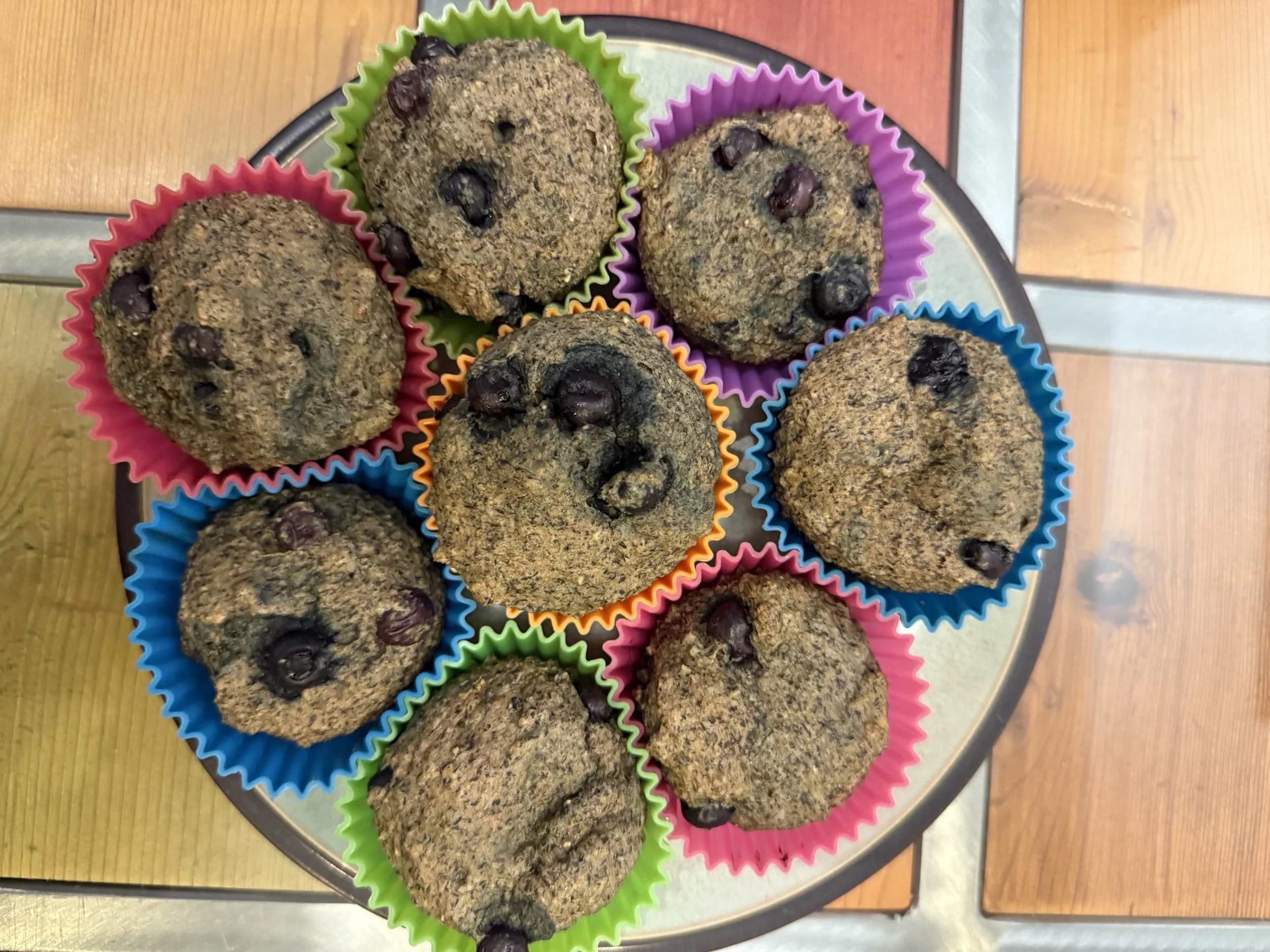
Buckwheat Almond Muffins
Adapted from NYT Martha Rose Shulman's "Buckwheat and Amaranth Muffins" and my friend, Jody!
These muffins are gluten and dairy free, high in fiber, and so moist. They can be made without any added sugar if you prefer an unsweetened option and/or seeking to better manage your blood sugar. If you find them not quite sweet enough, you could add a bit of a sweetener. I played with adding a small amount of 100% monk fruit and really enjoyed them. A more traditional sweetener could also be used.
Ingredients:
3/4 cup buckwheat flour
1/2 cup almond flour
2 teaspoon baking powder
1 teaspoon baking soda
1/4 cup chia seeds
1/4 cup whole psyllium husk
2 eggs
1 1/2 cup almond, coconut, or other milk
3 tablespoons avocado oil
¼ cup unsweetened apple sauce
1 teaspoon vanilla extract
Optional:
1 cup frozen blueberries
10 drops of 100% monk fruit or other sweetener
Instructions:
Preheat oven to 350 F.
Mix milk and chia seeds, stir and let rest, stirring occasionally, allow to soak for at least 5 minutes.
In a separate bowl, stir together remaining dry ingredients.
Stir together remaining wet ingredients in another bowl.
Combine all ingredients and portion into 12 muffin containers.
Bake for about 20 minutes, try to avoid browning.
Red Lentil Curry and Sweet Potatoes Recipe
Recipe adapted from NY Times.
This is a great plant-based recipe brimming with fiber and flavor!
Ingredients:
Spritz’s of avocado oil or extra-virgin olive oil
2-3 medium sweet potatoes, peeled and cut into 3/4 inch cubes
1 medium yellow onion, chopped
3 tablespoon red curry paste
3 garlic cloves, minced
1-inch piece of fresh ginger, grated
1 red chile, seeds and ribs removed and minced
1 teaspoon ground turmeric
1 cup red lentils, rinsed
4 cups vegetable broth
6-12 ounces coconut milk
4 cups (or more) of spinach or Power greens
juice of 1/2 lime
cilantro for garnish
optional: unsweetened coconut flakes for garnish
Instructions:
Spritz pot or dutch oven with oil over medium heat. Add the sweet potato cubes and cook, stirring occasionally, until browned all over. Transfer the potatoes to a plate and set aside.
Spritz the pot again with oil and lower the heat slightly. Add the onions and cook until translucent, around 2-5 minutes. Add the curry paste, garlic, ginger, chile and turmeric and cook until fragrant, ~1 minute.
Add the lentils, broth, and browned sweet potatoes to the pot and bring to boil over high heat. Lower the heat and simmer uncovered, stirring occasionally, until the lentils are just tender, 20 to 25 minutes.
Add the coconut milk and simmer, stirring occasionally, until the liquid has reduced and the lentils are creamy, 15 to 20 minutes
Add the greens and stir until just wilted, 2 to 3 minutes. Take the pan off heat and stir in the lime juice and salt if desired
Garnish with cilantro and unsweetened coconut.
Berry Cauliflower Smoothie
My goal here was to boost the fiber with the berries, riced cauliflower, flax, and chia. You could certainly adjust the ingredients to your palate and health goals.
Ingredients:
½ cup berries
½ banana
1 cup frozen riced cauliflower
1 tablespoon ground flax
1 tablespoon chia seeds
1 cup almond, coconut, or ‘milk’ of choice
1 inch piece of fresh ginger
For protein, add 4 ounces tofu, 1 cup Greek yogurt, or 1 serving protein powder
Instructions:
Blend all ingredients together and enjoy!
Fiber up, but gradually!
In Health,
Natalie